
Edwards Parole and Probation Compared
Parole and probation can both place a person in the community under rules, but they begin in different ways. Illinois Department of Corrections supervises people released from state prison to parole or mandatory supervised release, often shortened to MSR. The Illinois Prisoner Review Board handles duties assigned by statute, including some conditions, hearings, revocation matters, and discharge decisions. Edwards County probation comes from a circuit court sentence. It is served through the judicial probation and court-services system, and the person may never have entered an IDOC prison.
The Edwards criminal docket is the best first source when the legal type is unclear. A sentencing order may impose probation, commit the person to IDOC, award custody credit, or set another disposition. Disappearance from the White County Jail site cannot settle that question. The person might have been released under a court order, transferred to IDOC, or moved to another authority.
| Point | Parole or MSR | Probation |
|---|---|---|
| How it begins | Release from an IDOC prison term to state supervision | Sentence imposed by the Edwards County circuit court |
| Public proof | IDOC status, location, dates, and applicable PRB records | Sentencing order, docket entries, and later discharge order |
| Public office route | IDOC contact and the Prisoner Review Board | Illinois Courts probation directory and circuit clerk |
| End point | Discharge from state supervision | Court-recorded completion or discharge |
A public result should be read narrowly. An IDOC status of PAROLE shows release from prison to active state supervision. It does not mean the whole sentence is finished. A probation judgment likewise proves the sentence type, not that every private case-management detail is public.
- Parole
- Conditional community release in a case governed by the applicable Illinois parole law.
- Mandatory supervised release
- A state supervision term that follows prison for many determinate sentences.
- Probation
- A court sentence served in the community under judicial supervision.
- Discharge
- The formal end of the sentence or supervision term.
Verify Edwards Post-Release Supervision
Start with the Edwards County court case because the order explains the path out of local custody. The Edwards Circuit Clerk search page routes users to electronic case access. Search by case number when possible, then read the chronology for sentencing, probation, mittimus, release, warrant, and later discharge entries. A mittimus is the court document directing custody or execution of a sentence. Obtain the order from the clerk when a coded docket entry is not clear.
- Match the full name, birth information, case number, and approximate dates. Do not rely on a same-name result.
- Read the Edwards sentencing order. Determine whether it imposed probation or committed the person to IDOC.
- For state supervision, open the IDOC Individual in Custody Search and search by IDOC number, last name, or birthdate.
- On the matching IDOC detail, read
Offender Status, location,Last Paroled Date, and projected dates together. - For probation, use the Illinois Courts probation directory to identify the current office serving Edwards County.
- Request the public order or docketed discharge from the clerk or proper agency when formal proof is needed.
IDOC warns that a fully discharged person may no longer appear. A no-result search does not prove there was no state sentence or parole term. Return to the Edwards judgment, then use an IDOC records inquiry if the state history is material. For the broader release trail, the Edwards County released-inmate search explains how the court, sheriff, White County Jail, and IDOC records fit together.
Note: A projected state date forecasts an event; a current status and dated record are better evidence that release or discharge actually occurred.
Edwards Supervision Office Routes
No stable Edwards-specific staff name, street office, or reporting schedule was established in the research. That makes the official directories more reliable than copied business listings. People under supervision should use the contact instructions issued in their own case. A member of the public seeking a record should ask for the public status or order, not private notes, treatment details, an address, or an internal assessment.
State parole and MSR
Illinois Department of Corrections
Current IDOC contact routes
Public Information Office
1301 Concordia Court
P.O. Box 19277
Springfield, IL 62794-9277
Edwards County probation
Illinois Courts
Probation and Court Services Directory
Use the live directory to confirm the office now serving Edwards County.
The Prisoner Review Board is a decision and hearing source, not a substitute reporting office. Its operations and hearing hub separates hearing schedules, decisions, and revocation materials. The type and date of each item matter.
Edwards Supervision Conditions and Endings
Conditions depend on the judgment, statute, and agency instructions. They can set reporting duties and limits while supervision remains active. Public database fields do not replace the written terms given to the supervised person. A suspected breach may lead to an allegation, warrant, hearing, or court action, but an allegation is not the same as a final finding. Likewise, a return to custody does not erase the earlier physical release.
Parole or MSR ends through the state process applicable to the sentence. Probation completion is best shown by the Edwards docket and a filed discharge or completion order. IDOC's Projected Discharge Date is forward-looking and differs from its Projected Parole Date. The first estimates the end of the state sentence and supervision; the second estimates physical release from prison to supervision. Both may change.
Illinois VINE can send custody-event alerts for a confirmed person record, but it does not prove probation status or create the release order. If an alert conflicts with the court or IDOC, ask the record-owning agency what event occurred and whether it was release to the community or transfer.
Edwards Parole Warrants and Absconders
Illinois has a statewide IDOC Wanted Fugitives page, but no Edwards-specific sheriff absconder list was identified. The state page is a focused warrant clue, not a roster of every person released on supervision. Absence does not establish good standing. Presence should be verified with the issuing authority before drawing any conclusion.
PRB revocation records address a different question. The Board's revocation hearing schedules identify proceedings, while published results may show what action followed. A scheduled matter concerns an alleged supervision problem. It does not by itself establish the outcome, and it should never be described as an ordinary Edwards County release list.
The official revocation source is shown below as a navigation aid.
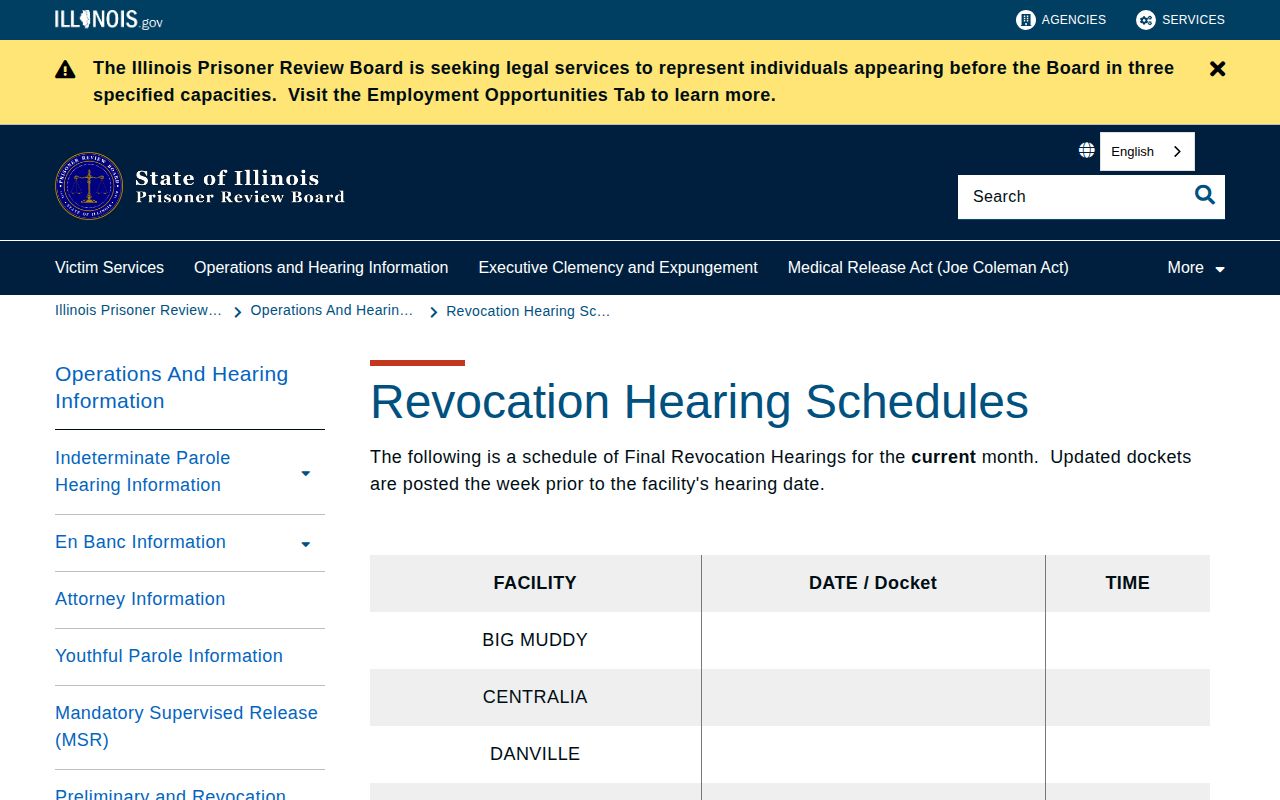
The dated schedule must be paired with a result or agency record before stating what the Board decided.
Note: A parole warrant or revocation event changes supervision status, but neither changes the fact that an earlier release from prison occurred.
Which Edwards Supervision Record Applies?
Legal type controls the lookup. An IDOC detail can display PAROLE and a parole-district location for someone outside prison under state supervision. Edwards probation is instead shown by the sentencing judgment, later court entries, and the office found through the Illinois Courts directory. Those systems are not interchangeable.
A White County Jail departure adds a third layer. White physically houses many Edwards prisoners under contract, yet the Edwards court owns the prosecution and judgment. Leaving White can mean community release, transfer to IDOC, movement on another warrant, or another authorized disposition. Obtain the jail departure authority when the route from custody to supervision is disputed.
For a state case, compare IDOC's status with the sentencing county, mittimus number, and sentence rows. For probation, compare the party name and case number with the actual Edwards order. This layered match reduces the risk of joining the wrong person or treating a transfer as a release.
Edwards Parole Decision Records
The Prisoner Review Board publishes several kinds of material, and each serves a narrow purpose. Hearing calendars show that a proceeding was set. Current decision pages report outcomes for a dated meeting. Past-parole material can help locate a historical grant. None of those records alone proves the time a person physically left a prison gate.
Modern determinate Illinois sentences commonly lead to mandatory supervised release rather than a discretionary parole grant. Older indeterminate cases may follow parole-hearing rules. A separate youthful-parole statute may apply to some qualifying cases. The judgment, offense date, and current law must identify the route before a Board record is described.
Pair a published grant with IDOC's Last Paroled Date, current status, or a requested release record. Release planning, another hold, or later action can separate the Board decision date from physical release. When citing a PDF, record its meeting date and proceeding type so an old decision is not mistaken for current status.
The same care applies to revocation results. They may document continued release, return to custody, or another lawful action. Quote only the result actually published and retain the original release as a separate event in the timeline.