
Edwards VINELink Custody Coverage
Illinois VINE through VINELink is a person-specific custody status and notification service. It receives information from participating agencies. For Edwards County, that role is especially useful because the county has one temporary holding cell rather than a normal jail with a public historical roster. White County Jail houses many Edwards detainees under contract, while IDOC handles people committed to state prison.
VINE can report the status supplied by a participating custodian and let a user register on the matching record. A released or out-of-custody label means the reporting agency recorded a custody event. It may not say whether the legal reason was a court order, sentence completion, or another disposition. It can also describe the end of one agency's custody when the person moved elsewhere.
Federal custody is outside this path. The Federal Bureau of Prisons locator covers BOP custody and historical federal releases, while ICE has a separate civil immigration locator. A White County transfer entry pointing to USMS, BOP, or ICE should trigger the correct federal check. VINELink absence does not prove federal release.
Search Edwards Inmates on VINELink
Prepare the identity details first. A full name is only a starting point. Add an offender or booking identifier when available, and compare jurisdiction, age or date information, and custody agency. Similar names can produce false matches and alarming notices. Do not register until the person and custody record align.
- Open the Illinois portal and select the person or custody search offered by the live interface.
- Enter the full name or available offender identifier. Try a known spelling variant if the first search fails.
- Review all results before opening one. Compare jurisdiction, custody agency, identifier, and available age details.
- Select only the confirmed Edwards or White County record, or the correct Illinois state record.
- Read the complete status and event wording. Save the retrieval date because dynamic custody data can change.
If there is no match, do not conclude that the person was released or never booked. The name may differ, coverage may vary, or data intake may lag. Contact the Edwards Sheriff for holding and transport information or White County Jail for contracted confinement. The Edwards County released inmate search adds the court, IDOC, and records-request paths.
Edwards VINELink Release Fields
The interface is dynamic, so exact labels can change. Read what the live Illinois record actually displays. Do not promise fields that are absent. VINE is not the custodian of a sheriff booking sheet, a jail release transaction, or the court order that authorizes release.
| Displayed item | How to read it |
|---|---|
| Name and identifier | Tools for matching the result to the intended person. |
| Jurisdiction or agency | The reporting custodian tied to the status. |
| Custody status | The agency's current event state, not a full legal history. |
| Facility or location | The reported custody site, which may change after transfer. |
| Event type | Release, transfer, return, escape, or another event offered by the system. |
| Event date | The date associated with the notice, subject to source timing. |
A “release” event may mark the end of White County's control without proving release to the community. Ask the jail for destination and authority. If it reports transfer to IDOC, use the state offender search after intake. IDOC's projected parole and projected discharge fields serve different purposes and should not be substituted for a VINE actual-event notice.
The Illinois VINELink entry screen is shown below as the official starting point.
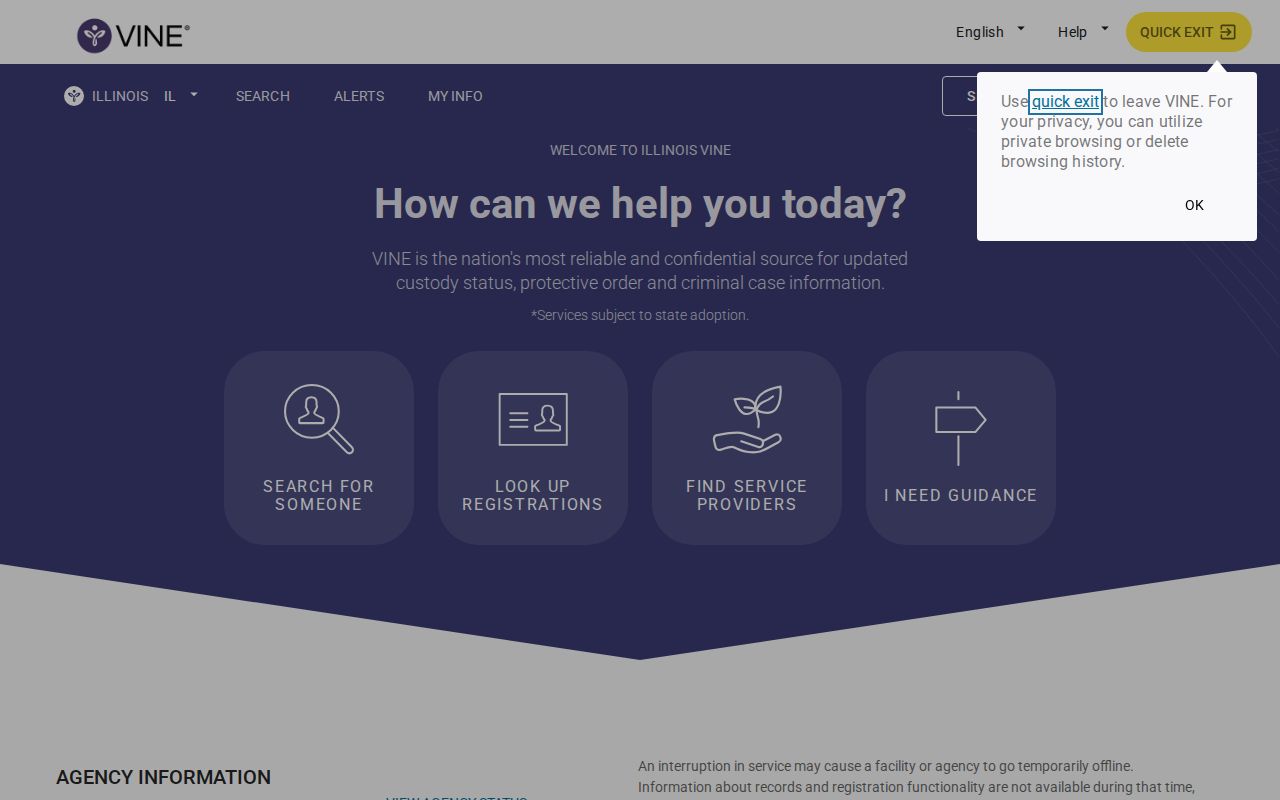
The screen identifies the state workflow, while the person record and registration steps appear only after a valid search.
Register Edwards Release Notifications
Registration belongs on the confirmed person record. Review the events and delivery channels offered in the live portal. Telephone and email may be available, but the menu can change. Keep contact data current and complete every confirmation step. A registration that was started but not confirmed may not produce an alert.
- Open the matched custody record and choose notification registration.
- Select the event types offered, such as release, transfer, or another custody change.
- Choose an available delivery channel and enter the requested phone or email details.
- Create or record the private PIN when prompted. Use it to acknowledge a telephone notice if the alert requests it.
- Finish confirmation and save the registration details privately. Never publish the PIN.
Read the complete alert. Event categories have distinct meanings, and a transfer can require another locator. Email may be filtered, phone calls may be missed, and app delivery can be delayed. Using more than one offered channel can help, but no notification method should replace direct contact when an immediate safety or legal issue exists.
Confirm Edwards VINELink Releases
VINE is a notice layer, not legal proof. Pair a reported event with the Edwards court order and the physical custodian's release or transfer transaction. The court can show authority. The jail record can show actual departure time and destination. Those timestamps may differ because staff must finish paperwork, check holds, and complete the discharge process.
If VINE says release while White County says transfer, ask both sources to clarify the event category. Prefer the custodian's documented destination for describing what happened next. A notification service may report that custody ended at one facility without providing the full receiving-agency context.
For IDOC involvement, use the official Illinois offender search. A status of PAROLE indicates that the person is outside prison under state supervision. A fully discharged person may not remain searchable, so no state match is not proof of a local release. Preserve the Edwards case and request the official records.
Note: A VINE event should always be dated because custody status and participating-agency data can change after the lookup.
VINE Bridges Edwards Feed Gaps
Illinois VINE provides the distinctive local bridge created by Edwards County's lack of a normal jail release feed. It can watch a confirmed participating record while a person remains in the custody stream. That makes it more useful than repeatedly checking for a county list that does not exist. The value depends on selecting the right person before registration.
The bridge has firm limits. VINE does not create the White County release record, decide the release reason, or supply the Edwards court order. Its alert can prompt the next check. White County remains the source for the departure transaction when it held the person, while Edwards County remains the source for its case and some initial processing records.
Separate Illinois State Police registries do not fill this gap for the public at large. They apply only when a statutory registration duty exists. Presence may corroborate a specific status, but absence says nothing about whether an ordinary Edwards detainee is still held or was released. Never infer registry duty from a charge alone.
A status dispute should be routed to the office that owns the fact. White County can explain its booking and departure transaction. The Edwards Circuit Clerk can supply the release, sentencing, or mittimus order in the criminal case. IDOC can address a state profile, and VINE support can address a stale alert or registration problem. One source should not be asked to correct another agency's record.
For a formal county record request, identify the person and date range and ask for the booking sheet plus the release or transfer transaction. Include the Edwards case number and White booking number when known. Ask for actual departure date and time, legal authority, and receiving destination. Request existing electronic records, since Illinois FOIA does not require an agency to create a new explanation or custom report. A narrow request is easier to route and less likely to return an unrelated current roster.
VINE registration also benefits from careful record keeping. Save the date of the search, the selected jurisdiction, the masked destination used for alerts, and the confirmation status. Keep the PIN private. If no notice arrives, review spam filters or phone settings, confirm the registration in the live service, and contact the custodian for the current event. Do not assume silence means that custody continued.
After an alert, compare the event with the court and jail sources. A release order can precede physical departure. A facility release can be followed by supervision or transfer. IDOC's Projected Parole Date is a changeable estimate, while Last Paroled Date is an event field when populated and Projected Discharge Date concerns the anticipated end of sentence or supervision. Those state labels should remain distinct.
When a person is under state supervision, a parole-district location is not a home address and must not be presented as one. When the Edwards sentence instead imposed probation, verification belongs in the Edwards case and the Illinois Courts probation directory, not in a VINE custody alert. Pretrial conditions are also distinct from probation. Reading the underlying order keeps these legal stages separate and avoids turning a simple custody notice into an unsupported claim about sentence completion.
Operational emergencies should go to law enforcement, not to a portal refresh. VINE itself should not be the sole protective measure. A saved alert helps with awareness, while direct agency contact supplies current custody facts. If a stale status persists, report it through VINE support and ask the custodian for the authoritative event. Record whether the source was unavailable, returned no match, or affirmatively reported no record, since those findings are not interchangeable.
Search results should be handled with care. Do not publish a date of birth, identifier, PIN, phone number, or email beyond what is needed to distinguish a result. Physical descriptions and photographs can change, so pair them with stable case or booking facts. Privacy and accuracy both improve when only the minimum matching detail is retained.