
Edwards Projected and Actual Release
A projected date is an estimate made from the sentence and information known at the time. An actual release date records a completed physical event. For an IDOC prisoner, the public detail uses the exact fields Projected Parole Date and Projected Discharge Date. The parole date anticipates physical release from prison to state supervision. The discharge date anticipates the end of the sentence and supervision. They are not synonyms.
Local custody follows another track. Edwards County has one temporary holding cell and no conventional jail. People held longer may be housed under contract at White County Jail. A person held before trial leaves only when a court order or other lawful authority permits it and all holds are resolved. There may be no fixed future date. For a sentenced local term, ask the court and White County about the applicable calculation rather than importing an IDOC date.
A court order and a gate time answer different questions. The order supplies legal authority. Jail staff then check holds, finish paperwork, settle property, and record physical departure or transfer. A dated court order alone should not be reported as the exact moment a person entered the community.
Find an Edwards Projected Release Date
Begin with the Edwards case. The judgment reveals whether the person remains in pretrial custody, serves a local sentence, received probation, or was committed to IDOC. Because Edwards prisoners can be held in White County, the county of prosecution and the physical custodian may differ. A current roster only addresses present custody and cannot prove a past release or calculate a state sentence.
- Use the Edwards Circuit Clerk search route and match the case number, name, and dates.
- Read the judgment, mittimus, custody-credit entries, warrants, and later amended orders. A mittimus is the court's custody directive.
- If the case remains local, ask the Edwards Sheriff or White County Jail which agency holds the person and whether a local sentence calculation exists.
- If the judgment committed the person to state prison, open the official IDOC search landing page.
- Search by IDOC number when known, or use last name or birthdate and verify the sentencing county, mittimus, offense, and date of birth.
- Read the projected parole and projected discharge fields separately, then save the retrieval date because the data can change.
- Confirm a completed event through status,
Last Paroled Date, a release record, and the court rather than relying on the former projection.
The full Edwards release trail is covered through the Edwards County released-inmate search. It explains why the Edwards court, White County custodian, and IDOC record may each hold a different part of the same event.
The live IDOC search screen shows its three verified inputs.
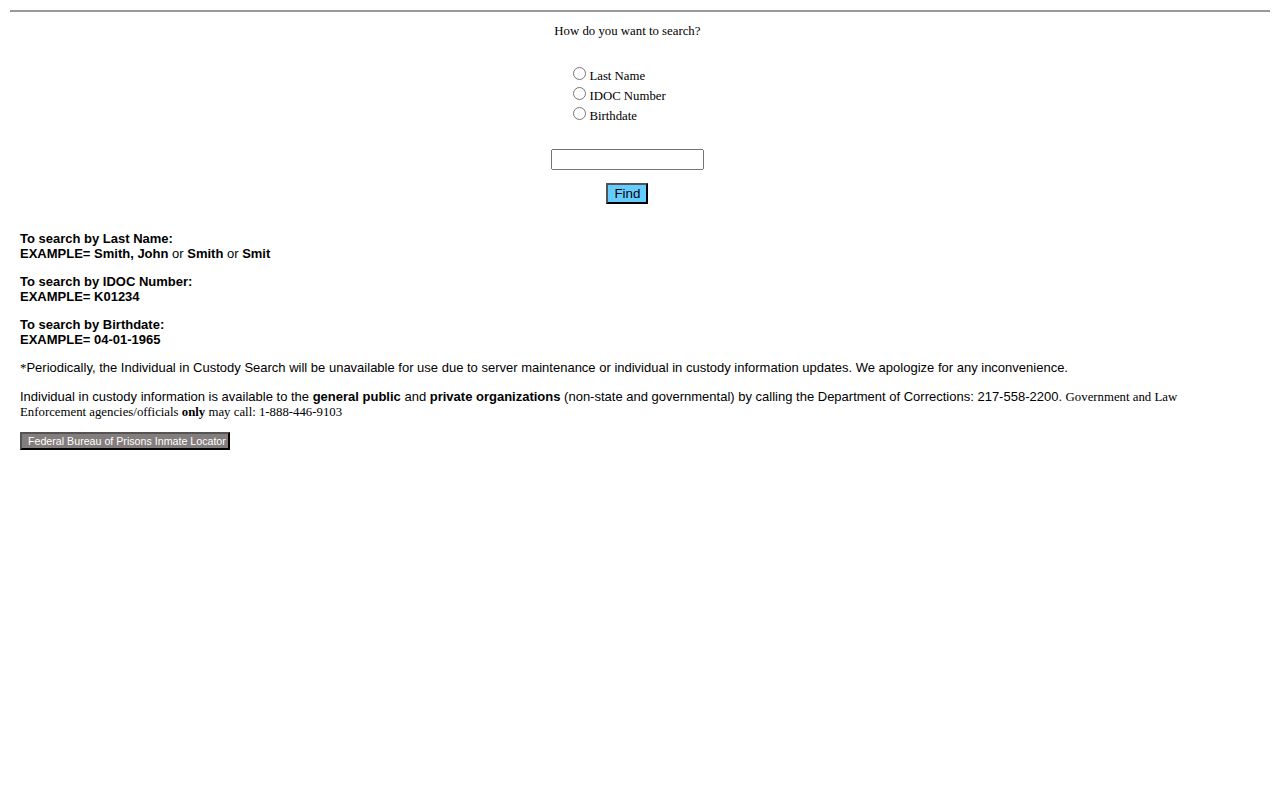
Use a partial last name with care; an IDOC number is a stronger way to isolate the correct state record.
Edwards Release Credits and Sentences
Illinois sentence credit is governed by 730 ILCS 5/3-6-3. The calculation begins with the sentence, custody date, court-awarded presentence credit, and whether multiple terms run together or one after another. The controlling offense, offense date, and statutory tier determine the credit ceiling. Some earned or discretionary credits depend on eligibility, program work, or an administrative award.
The phrase "85% rule" is only shorthand for one part of a tiered law. For specified offenses, the statute limits credit to no more than 4.5 days per month, which is roughly 85 percent service of the custodial term. It is not a statewide formula for every conviction. Other categories have different caps, exclusions, or no-credit rules. A plain-language charge label cannot safely identify the right subsection.
Mandatory supervised release is governed chiefly by 730 ILCS 5/5-8-1(d), subject to the applicable judgment and offense law. That term helps explain why the projected prison-release date and projected discharge date differ. One marks the expected move out of prison; the other anticipates the end of state control.
Note: Use the conviction and offense date with the current statutory text; a generic online sentence calculator cannot resolve an Edwards case reliably.
Why Edwards Release Dates Change
A projection moves when one of its inputs changes. IDOC states that public information changes, so an undated screen capture is weak evidence. Some changes come from the court. Others result from credit administration, discipline, or a new hold. The effect cannot be predicted without the governing record.
| Change | Possible effect | Best source |
|---|---|---|
| Credit award or restoration | May move the prison projection earlier | IDOC sentence calculation and statute |
| Credit revocation | May move the projection later | IDOC disciplinary and calculation record |
| Amended judgment or mittimus | May change sentence inputs or custody credit | Edwards court order |
| New or consecutive sentence | May extend the custody period | Court and IDOC sentence rows |
| Warrant or detainer | May block community departure or cause transfer | Custodian release transaction |
| Administrative correction | May move either projected field | IDOC confirmation |
A detainer is a request or notice from another authority that may affect what happens when current custody ends. If White County transfers a person to IDOC, another county, USMS, or ICE, departure from the jail is not release to the community. Ask for the receiving agency and legal authority.
Confirm Edwards Actual Release Dates
IDOC's Offender Status and Last Paroled Date can help confirm that a projected state event occurred. A status of PAROLE means the person is outside prison under active state supervision. It does not mean the sentence is discharged. If the profile is missing, IDOC warns that sentence and parole completion may remove a discharged person from results. Use the Edwards judgment and an IDOC records request as fallbacks.
For local custody, request the actual departure date and time, release reason or authority, and destination if transferred. The court supplies the order, while Edwards or White records when staff executed it. Illinois VINE can add an alert for a matching participating record. The VINELink inmate search is useful for notice, but the custodian remains the source for why and where the person left.
IDOC directs factual and completeness questions to its Public Information Office at 1301 Concordia Court, P.O. Box 19277, Springfield, IL 62794-9277. A narrow inquiry should include the IDOC number, Edwards case or mittimus, the exact date field in dispute, and the retrieval date.
Note: A fully discharged person may vanish from the public IDOC search even though court and agency records of the sentence still exist.
Three Edwards Release Clocks
An Edwards case can produce three distinct clocks. First, the circuit court authorizes a local release or imposes the judgment. Second, the holding agency records physical departure after processing all orders and holds. Third, after admission to state prison, IDOC calculates projected parole and discharge dates under Illinois law. Combining those clocks creates false precision.
No published Edwards-specific local good-time policy was found. White County should be asked for the authority and calculation it applies to a local sentence. IDOC's statutory tiers should not be pasted onto a pretrial stay or a county calculation. Conversely, a White County estimate cannot replace an IDOC projection after prison admission.
The strongest timeline names each source: court order date, jail departure date and destination, IDOC admission, projected parole date, actual parole event when populated, and projected or actual discharge. That format makes clear which events happened and which remain estimates.
A projection should always carry an as-of date. Dynamic records can change without warning as courts enter new orders and correctional staff update calculations.
Read Edwards IDOC Date Fields
A matching IDOC detail contains more than one date. It may show admission, projected parole, last paroled, and projected discharge information along with status and location. Sentence rows may list the mittimus or case, offense, class, custody date, sentence, county, and whether a sentence is discharged. One sentence can be discharged while another remains active.
Read the date fields with status. Projected Parole Date is a mutable estimate. Last Paroled Date, when populated, records a prior parole event, but the present status still controls the current description. Projected Discharge Date estimates the end of sentence and supervision. It should not be reported as the date the person walks out of prison.
The location field can add context. A parole-district location with PAROLE supports physical release to active state supervision. A parent institution and in-custody status point to state confinement. Match the Edwards sentencing county and mittimus before joining any profile to the local case.
If several profiles share a name, do not select by appearance. Use IDOC number, birthdate, sentence county, case data, and custody dates. A wrong match turns a sound date field into a false claim.
Edwards Date Record Fallback
A missing IDOC result has several possible causes. The person may be in county custody, held by another state, searched under a different name, or fully discharged after sentence and parole completion. The public warning specifically allows for discharged records to be absent. "Not found" does not mean no sentence or release record exists.
Use the Edwards court case as the durable fallback. Request the judgment, mittimus, amended orders, and custody-credit entries. For state calculations, use the Illinois FOIA contacts directory and select the Department of Corrections. State the exact field or calculation sought, provide an IDOC number and Edwards case when known, and ask for electronic records with lawful redaction.
For a local sentence, direct the question to the actual custodian. Edwards owns initial holding and transport records; White may own confinement and departure data. A narrow request for the calculation authority, actual release time, release reason, and transfer destination produces a more useful answer than asking whether a name is still on a roster.